

What Is Data Annotation? Complete Guide for AI Teams (2026)
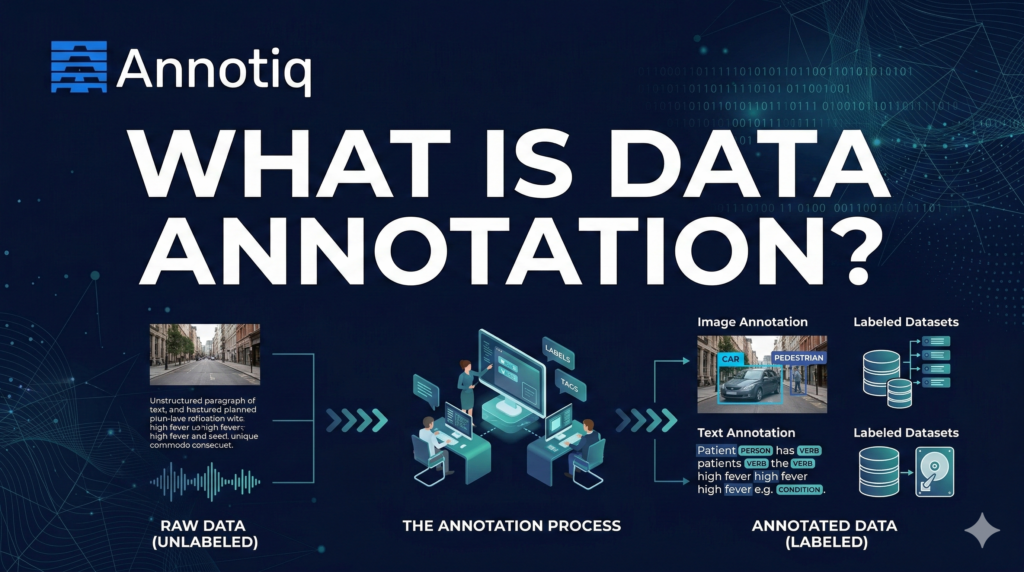
If you’ve ever wondered how an AI model learns the difference between a tumor and “just a shadow,” or a pedestrian and a mailbox, here’s the unglamorous truth: It’s not magic. It’s labeled data. Data annotation is the process of adding labels to raw data so machine learning models can learn from it. Those labels can be categories, bounding boxes, polygons, text spans, timestamps, ratings, or preference rankings. Most enterprise data is unstructured, including documents, emails, images, audio, video, and logs. Many industry estimates put unstructured data at 80% to 90% of enterprise data, which is one reason AI teams spend so much time turning raw data into training-ready datasets This article explains what data annotation is, why it matters, the main annotation types, common workflows, quality controls, cost drivers, and what to look for in an annotation partner. Data annotation in one sentence Data annotation turns raw data into labeled examples that machine learning models can learn from. If the model is the brain, annotation is the childhood education phase. Why data annotation matters A model’s performance is limited by the quality and consistency of its training data. Annotation is where teams decide: Bad labels don’t just lower accuracy. They create models that are confidently wrong. Which is the worst kind of wrong. Data labeling vs. data annotation: are they different? In practice, people use them interchangeably. Data labeling usually refers to simpler tasks such as assigning a category to an item. Data annotation is broader. It includes structured markup such as: Same family. Different levels of effort (and invoices). Types of data annotation 1) Image annotation Image annotation powers computer vision, anything that needs a machine to “see.” Used in: A) Image classification (tagging) What it is: Apply one (or many) labels to the entire image. Examples: Pros: fast and cheap Cons: doesn’t tell the model where the object is B) Object detection (bounding boxes) What it is: Draw rectangles around objects + assign a label. Examples: Pros: strong baseline for many tasks Cons: boxes are not precise for irregular shapes C) Instance segmentation (polygons / masks) What it is: Outline each object precisely, so each instance is separated. Example: Detect and outline each tumor region separately. Typical tools: polygon annotation, brush masks, AI-assisted segmentation Pros: high precision; better for measurement and complex shapes Cons: slower and more expensive D) Semantic segmentation (pixel-level class labeling) What it is: Every pixel gets a class label. Example: In autonomous driving: Pros: extremely useful for “scene understanding” Cons: labor-intensive; guidelines must be extremely clear E) Keypoints (pose estimation) What it is: Place points on anatomical landmarks or joints. Examples: Use cases: F) OCR labeling (text in images) What it is: Mark text regions so a model learns to extract or recognize text. Common labels: Used for invoices, IDs, medical forms, packaging, signage. G) Panoptic segmentation What it is: Combines semantic + instance segmentation. Best for: complex real-world scenes. 2) Video annotation Video annotation is image annotation… plus time Used in: A) Video classification What it is: Label the whole clip. Examples: B) Object tracking (boxes or masks over time) What it is: Identify an object once and track it across frames. Common outputs: Key feature: interpolation (auto-filling in-between frames) C) Action and event annotation What it is: Label timestamps when something happens. Examples: Why it’s hard: edge cases. Humans disagree on when “the action” starts. D) Video captioning What it is: Natural language descriptions of what happens in the clip. Used for: search, accessibility, video understanding models. 3) Text annotation Text annotation makes language machine-readable. Used in: A) Text classification Label a document/message with categories. Examples: B) Named Entity Recognition (NER) NER highlights spans of text and labels them. Common entity types: C) Relationship annotation Label connections between entities. Examples: D) Coreference annotation Mark phrases that refer to the same thing. Example: “Dr. Smith… she…” → “she” refers to “Dr. Smith” E) Document layout annotation (forms, PDFs) This is big in healthcare and finance. Labels include: 4) Audio annotation Audio annotation is how machines learn to understand sound. Used in: A) Transcription Convert speech to text. Variants: B) Speaker diarization labeling Who spoke when. Labels: C) Audio event labeling Label sound events in time: D) Emotion / sentiment labeling (careful!) Used in call centers, but: 5) LiDAR and 3D annotation LiDAR is 3D point clouds, often fused with cameras and radar. Used in: A) 3D bounding boxes (cuboids) Draw 3D boxes around objects in the point cloud. Labels: B) Point cloud segmentation Assign labels to points (or clusters). Examples: C) Tracking in 3D Track objects through time (like video tracking, but 3D). D) Sensor fusion annotation Align camera + LiDAR + radar: Data annotation examples Image annotation example A medical image is labeled with a bounding box around a lung nodule and tagged as suspicious lesion. Text annotation example In the sentence “Patient was prescribed 5 mg of amlodipine,” the labeler marks “amlodipine” as Medication and “5 mg” as Dosage. Audio annotation example A call recording is transcribed, split by speaker, and labeled for escalation intent. LLM annotation example Two model answers to the same prompt are compared. The reviewer picks the one that is more accurate, safer, and follows the instruction better. Choosing the right annotation type Pick the simplest annotation method that still supports the model goal. A practical rule: The data annotation workflow A solid annotation pipeline usually follows five steps. What “high-quality annotation” actually means High-quality annotation is not “we labeled a lot of things.” It’s: What drives data annotation cost? In simple terms, image classification costs less than segmentation, and basic transcription costs less than expert-reviewed medical or legal annotation. Common challenges (and how to avoid them) Inconsistent labels Fix with: tighter guidelines, better examples, calibration sessions, and structured review. Hidden bias Fix with: representative sampling, subgroup checks, and explicit fairness review—especially in healthcare and people-centered datasets. Privacy and compliance Fix with: de-identification/redaction workflows, access controls, and a “minimum necessary” mindset for sensitive data. “We’ll
How Data Annotation Is Transforming Healthcare AI: Inside the OneMedNet-Medcase Partnership

The Silent Revolution in Healthcare AI The quietest revolutions in technology rarely make headlines.Sometimes, they don’t involve shiny new apps or groundbreaking models, but the invisible work behind the curtain: data quality. This is the story behind the OneMedNet–Medcase partnership, a collaboration designed not to reinvent AI itself, but to improve the data that feeds it. This partnership showcases how healthcare data annotation is driving innovation in medical AI and real-world healthcare data pipelines. As AI continues to transform healthcare, from radiology to diagnostics, the biggest challenge becomes trustworthy, annotated data. And that’s where this alliance changes the game. In essence, the partnership unites OneMedNet’s iRWD™ (intelligent Real-World Data) platform with Medcase’s network of 15,000+ medical professionals, creating a pipeline of clean, expertly labelled, and ethically managed healthcare datasets. This is the infrastructure that makes breakthroughs possible. The Power of Data Annotation What Healthcare Data Annotation Really Means Healthcare data annotation is the process of labelling complex medical data, images, clinical notes, lab reports, and EHRs, so AI systems can learn to interpret them accurately. But in medicine, annotation isn’t just labelling pixels or tagging keywords. It’s about contextual understanding. Clean, structured healthcare data annotation ensures AI systems perform reliably across medical imaging, diagnostics, and EHR analytics AI models are powerful pattern recognizers, but they lack empathy, intuition, and domain knowledge.That’s why this partnership matters; it represents a commitment to responsible data automation, not replacement.AI learns better when data is annotated more intelligently. The OneMedNet-Medcase Partnership Explained Who Are OneMedNet and Medcase? How This Collaboration Enhances Real-World Medical Data By joining forces, these two players are closing the gap between data supply and data reliability.Medcase’s human expertise now enhances OneMedNet’s vast, structured RWD pipeline, producing annotated datasets ready for ethical AI model training. This partnership redefines what “AI-ready data” means in healthcare. Why Data Annotation Matters More Than Ever AI adoption in medicine has reached an inflection point. Regulatory scrutiny, ethical expectations, and patient safety all depend on transparent, auditable data pipelines. While full automation alone can’t ensure clinical precision, AI-driven healthcare data annotation pipelines supported by expert review deliver the best of both worlds: scalable automation with ethical oversight. This partnership celebrates precision over speed and quality over quantity, the foundation of responsible AI. From Flashy AI Models to Clean Data Pipelines For years, healthcare AI’s spotlight has been on model performance, radiology assistants, predictive algorithms, and digital twins. But the real question isn’t how smart a model is, it’s how clean its data is. The industry is shifting from model-centric AI to data-centric AI, where the competitive advantage lies in how well your data is collected, labelled, and governed. Clean data is the new competitive edge. This partnership embodies that shift, showing that the real innovation happens before the model is even trained. Key Advantages of the OneMedNet-Medcase Alliance 1. Domain Expertise at Scale You can’t crowdsource medical meaning. With Medcase’s global clinician network, OneMedNet gains access to domain-informed data annotation that aligns with clinical standards and real-world applications. 2. Regulatory-Grade Trust AI models in healthcare must meet stringent ethical and safety standards. Governed data annotation pipelines build audit-ready, traceable datasets that can stand up to regulatory review. 3. Market Momentum The healthcare data annotation market, valued at $1.5 billion in 2025, is expected to nearly double by 2030.This signals growing recognition that AI quality = data quality × human expertise. 4. Pipeline Precision From de-identified data to AI-ready insights, the OneMedNet–Medcase workflow creates a seamless annotation pipeline, which is the true infrastructure of healthcare AI. The $1.5B Data Annotation Market Healthcare annotation has become one of the fastest-growing sub-sectors in AI infrastructure.Drivers include: By 2030, analysts project the healthcare data annotation market will surpass $3 billion, led by automated, human-in-the-loop pipelines. Source: Grand View Research The Role of De-Identification and Privacy Every data point used in AI training carries patient information and, therefore, ethical risk.That’s why de-identification and data governance are critical. OneMedNet’s iRWD™ platform ensures every dataset is fully de-identified before annotation, preserving both compliance and patient privacy. The result? Datasets that are useful, lawful, and ethical, the holy trinity of medical data science. AI-Powered Data Annotation Pipelines When AI-driven annotation tools meet domain-informed validation, the result is transformative.Automated systems deliver speed and consistency, while governance frameworks ensure integrity and context remain intact. This partnership underscores a future where AI annotation enhances human judgment, rather than replacing it.. How Annotiq Interprets This Shift At Annotiq, we’ve long argued that AI is only as ethical as its data pipeline.This partnership validates that belief, proving that automated healthcare data annotation is the bedrock of responsible AI. Our mission is to automate and accelerate healthcare data annotation with built-in governance and quality controls, aligning directly with the industry’s move toward scalable, ethical annotation frameworks. The winners in healthcare AI will be those who can scale precision, not just volume. The Future of Healthcare Data Annotation Looking ahead, expect data annotation to become the core discipline of AI ethics and accuracy.Hospitals, startups, and research labs will increasingly depend on curated, AI-powered annotation and human-reviewed datasets to train systems that impact real lives. Future innovations will likely include: Case Scenarios Example 1: Radiology AnnotationAn AI trained on expertly annotated imaging data identifies subtle anomalies missed in generic datasets, improving early detection rates by nearly 12%. Example 2: EHR-Based Predictive AnalyticsAI-driven annotation of EHR data reduces demographic bias, improving fairness in predictive outcomes for chronic diseases. Common Myths About Data Annotation Myth 1: Annotation is fully automated.→ False. The best systems combine AI automation with governance-based validation Myth 2: Data annotation slows progress.→ In reality, automated healthcare data annotation pipelines prevent costly errors and accelerate regulatory approval. Myth 3: Labelling doesn’t affect model performance.→ Clean, governed annotation can improve model accuracy by up to 30%, especially in medical imaging. Key Takeaways FAQs 1. What is healthcare data annotation?It’s the process of labelling medical data (images, EHRs, or clinical text) to train AI systems with accurate context and meaning. 2. Why is
10 Hidden Ways You Data Annotation Shapes Your Daily Life

Data annotation might sound like something tucked away in a research lab or a tech startup’s basement, but in truth, it’s all around us. Every time we unlock our phones, binge-watch shows, or even walk into a grocery store, annotation has played a quiet role. It’s the invisible ink that makes artificial intelligence readable. Most people don’t think about it, but without data annotation, AI would be like a kid trying to play charades with no clues. By labeling, categorizing, and tagging real-world data, annotation helps machines understand the messy, nuanced world we live in. The fun part? It shows up in places we rarely expect. Let’s take a walk through 10 everyday spots where data annotation makes your life smoother, easier, and maybe even a little more magical. 1. Unlocking Your Phone with Face ID You glance at your phone, and voilà, it unlocks. Seamless. But behind that instant recognition is years of annotated data. Behind the Scenes: Labeled Faces & Expressions Your phone doesn’t “just know” your face. Thousands (sometimes millions) of facial images were carefully labeled, eyes, eyebrows, nose, jawlines, to help AI understand what makes a face unique. Data annotation also covers different lighting, angles, and expressions, so whether you’re half-asleep or laughing, the AI still recognizes you. 2. Streaming Services That “Know” Your Taste Ever wonder how Netflix or Spotify seems eerily tuned to your mood? That’s annotation doing the heavy lifting. Annotated Content & Recommendation Engines Every show, song, and movie has been labeled by genre, mood, actors, tempo, even dialogue cues. By matching those tags with your viewing or listening history, recommendation engines can suggest exactly what you’re likely to binge next. It’s like a digital friend who always knows your “comfort show” 3. Online Shopping That Feels Almost Psychic You browse once, and suddenly your feed is filled with the perfect shoes, coffee makers, or cozy sweaters you didn’t know you needed. Product Images, Reviews & Personalization Annotation powers product tagging: images labeled with attributes (color, style, brand) and reviews labeled with sentiment (positive, negative, neutral). The result? E-commerce platforms can serve up items that match your preferences in real-time. Creepy? Yeah, maybe a little. Useful? Definitely. 4. Self-Driving Cars & Traffic Safety Self-driving cars may feel futuristic, but annotation is the reason they can hit the road today. Annotated Roads, Signs, and Pedestrians Autonomous vehicles rely on training data where every road sign, pedestrian, lane line, and traffic light is carefully labeled. Annotators literally draw boxes around objects in thousands of images to teach AI how to “see” the world. Without that, a car might confuse a shadow for a pothole 5. Customer Support Chatbots That “Get” You Ever typed into a support chat and got a surprisingly helpful response? That chatbot is smarter than it looks. Conversational AI Trained with Annotated Text Chatbots are fed annotated conversations where intent, tone, and meaning are labeled. Did the customer ask a question? Complain? Make a joke? Annotation helps the AI catch those nuances and respond like a human (on a good day). 6. Grocery Store Self-Checkout Machines You scan an apple at the self-checkout, and the machine knows whether it’s a Granny Smith or a Fuji. That’s annotation again. Object Recognition & Barcode Training Vision-based AI at checkout stations is trained on annotated images of fruits, vegetables, and barcodes. It learns subtle visual differences so it doesn’t confuse bananas with plantains. Annotation makes those “unexpected item in bagging area” moments a little less… frequent. 7. Healthcare Diagnostics & Medical Imaging Doctors increasingly rely on AI to assist with scans, and annotation is what makes that trust possible. Annotated Scans for AI-Assisted Doctors Radiology images; X-rays, MRIs, CT scans are labeled by experts to mark tumors, fractures, or anomalies. When an AI system reviews a scan, it’s comparing against this vast annotated library to help flag possible issues. It’s not replacing doctors, but it’s a second set of (very fast) eyes. 8. Social Media Feeds & Content Moderation Scrolling through your feed feels effortless, but annotation is what keeps it from being chaos. Labels for Hate Speech, Fake News & Ads Content moderation relies on annotation teams labeling offensive language, graphic content, or misinformation. Ads are annotated, too, so platforms can serve you “relevant” ones. Every meme you scroll past has probably been filtered by invisible annotation layers. 9. Smart Home Devices (Alexa, Google, Nest) You ask Alexa to play your favorite song, and somehow she knows exactly what you meant. Voice Annotation & Context Recognition Voice assistants are trained on thousands of annotated voice clips, capturing accents, tones, and even background noise. That way, when you mumble “turn on the lights,” they know what you mean and not to confuse it with “turn on The Office.” 10. Email Spam Filters & Fraud Detection That fraud email never makes it to your inbox thanks to… annotation. Annotated Messages that Teach AI What’s “Junk” Spam filters are trained on annotated datasets of emails labeled as spam or safe. Over time, the AI learns to catch suspicious patterns; misspellings, fake links, too-good-to-be-true offers. Annotation saves you from daily clutter and scams. Why Data Annotation Matters Data annotation is convenient and the foundation of safe, ethical, and reliable AI. From keeping our money secure to helping doctors save lives, annotation is the quiet partner in technological progress. Without it, AI is a guessing game. Where Annotiq Fits Into Your World At Annotiq, annotation is an art. From image labeling for healthcare to text annotation for smarter chatbots, Annotiq helps companies build AI systems that feel intuitive and human-centered. The future of AI isn’t about machines replacing us; it’s about machines understanding us. Annotation is the bridge, and Annotiq is helping lay down the planks. Learn more about how Annotiq shapes data into intelligence → FAQs Q1. What is data annotation in simple terms? It’s the process of labeling data; images, text, audio so that AI systems can understand and learn from it. Q2. Is data
AI Model Collapse: How AI Is Eating Itself to Death

Artificial intelligence is facing a slow self-destruction: a phenomenon called AI model collapse, where it learns from itself and the results are terrifying. Behind the dazzling progress of AI lies a quietly growing threat. As the internet floods with machine-generated content, AI companies are increasingly turning to this same content to train new models. Model collapse, where AI becomes dumber with every generation, degrading from genius to gibberish. When Machines Learn From Machines Let’s get straight to the point: AI systems are being trained on content made by other AIs. That sounds efficient… until you realize it’s like a photocopy of a photocopy; each version gets blurrier, less accurate, and more incoherent. AI model collapse is what happens when this recursive learning spirals out of control. Imagine AI with digital dementia, forgetting how to think, regurgitating nonsense, and hallucinating facts with unwavering confidence. This isn’t science fiction. It’s already happening. How AI Models Are Trained (And Why It’s a Problem) To understand why this matters, let’s rewind a bit. Modern AI models are built by training on vast datasets: billions of words, images, and sounds scraped from the internet. This treasure trove is mostly human-made: blog posts, Wikipedia pages, Reddit threads, code repositories, news articles, and more. But here’s the catch: that well is drying up. High-quality, human-created data is finite. We’ve already scraped most of it. So what do you do when the good stuff runs out? Apparently, you let AI feed itself. Why AI Models Collapse When Trained on AI Content This shortcut, using AI-generated content to train newer models, has a seductive appeal. It’s fast, cheap, and scales infinitely. But it’s also a data death spiral directly to AI model collapse. Here’s why: Even a few rounds of AI-on-AI training can wreck performance across tasks, comprehension, logic, and language fluency; all of it. The Flood: Millions of AI Posts Are Contaminating the Internet Every day, millions of AI-generated blog posts, product reviews, images, and social media comments flood the web. They look real. They sound convincing. But they’re not grounded in lived experience or human thought. Worse, they’re unlabeled. Which means future AI models won’t know what’s real and what’s synthetic. They’ll ingest this polluted stream of content and treat it all the same. Imagine trying to learn about world history by reading thousands of AI-generated Wikipedia knockoffs. Sounds like a bad idea? That’s exactly what’s happening, and exactly how AI model collapse accelerates. The Future of AI Reliability Is at Risk Let’s be blunt: if this continues, tomorrow’s AI will be fluent only in nonsense. We’re already seeing signs of this, with chatbots confidently spouting wrong answers, hallucinating citations, or “forgetting” how to do math. That’s early-stage AI model collapse. And the real kicker? No one knows how to fix it at scale. The only solution is prevention, feeding AI clean, human-made data. But time is running out. Annotiq’s Thought: Can We Stop AI From Imploding? Right now, AI companies are in a quiet arms race not to build the smartest model but to secure the last reserves of human-authored content. Private datasets. Closed forums. Offline books. Anything untouched by bots. If we don’t act now, by labeling AI content, preserving human knowledge, and investing in sustainable data practices, we risk building a future where machines speak fluently but say absolutely nothing. So ask yourself: when your next AI assistant gives you advice, will it be drawing from the wisdom of humans or just mimicking the echo of machines?
AI Doesn’t Feel Like Sci-Fi Anymore; I Guess That’s the Point

AI no longer feels like sci‑fi. From playlists to emails, discover how AI has quietly become an everyday superpower shaping modern life.
What My Coffee Maker Taught Me About Workflow Automation

Discover workflow automation best practices from a rogue smart coffee maker. 3 lessons, real data, and no-code tips to perk up any business process.
Mastering NLP Annotation: A Beginner’s Guide to Using Prodigy
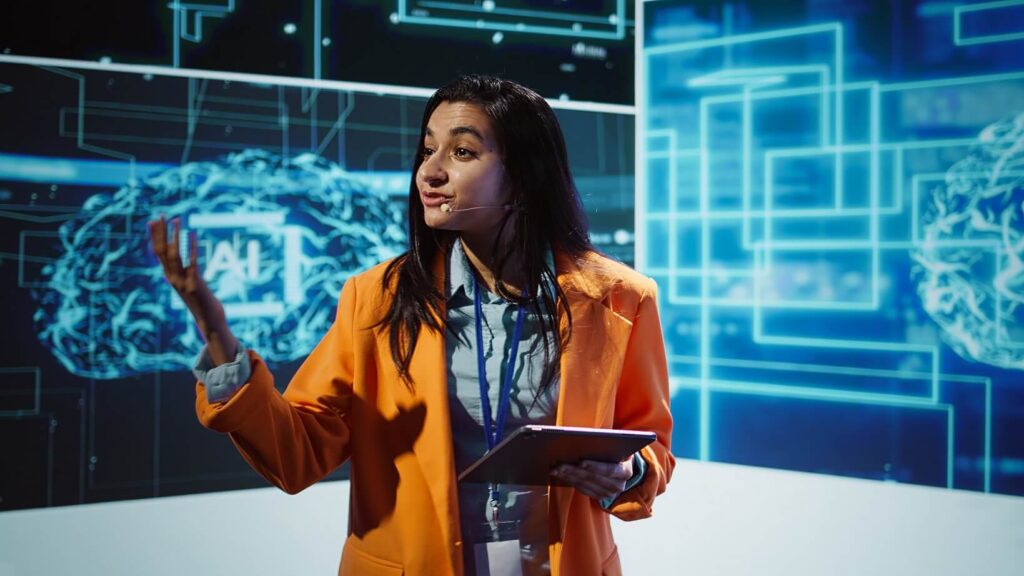
Smarter AI starts with better data. This guide shows how Prodigy, a powerful NLP annotation tool, helps teams label data faster, improve model accuracy, and cut busywork, whether you’re a CEO, data scientist, or just AI-curious.
Machines That Watch Us Grow Up

We don’t often think about the technology around us as emotional witnesses. But they are. We’re living with machines that watch us grow up and evolve with us.
AI for Medical Research: How V7 Is Fast-Tracking Innovation in Medical AI

AI medical research is evolving fast and the tools behind it are just as critical as the breakthroughs. Learn how V7 is helping businesses and research teams accelerate medical AI development with smarter annotation workflows, increased efficiency, and enterprise-ready compliance.
Labelbox vs. SuperAnnotate: Which AI Annotation Tool Moves the ROI Needle?

Welcome to the world of AI annotation tools: high-spec, feature-laden, and too often optimized for press releases instead of performance.