
A client once asked whether we could find someone to transcribe Urhobo. Fluent speakers are easy to find in Delta State. Fluent speakers who can also read Urhobo, spell it consistently, use annotation software and follow a twelve-page guideline written in English are much harder to find.
Today Annotiq works with native speaker annotators in ten African languages: Hausa, Yoruba, Igbo, Bini (Edo), Urhobo, Itsekiri, Efik, Ibibio, Fulfulde and Twi
Table of Contents
What a native speaker annotator needs
Growing up with a language is the starting point. On its own, it rarely produces good training data.
We look for four things:
- Home-language fluency in the right dialect: If the recordings come from Ibadan, the annotator should know how Ibadan speakers sound. Yoruba spoken in Oyo, Ekiti and Lagos differs in ways that change transcription.
- Literacy in the language: Many fluent speakers went to school in English and rarely write their home language. Writing Yoruba with tone marks, or Hausa with its hooked letters, is a separate skill.
- Comfort with guidelines: Annotation means following written rules exactly, even when your instinct says otherwise. Some excellent speakers find this frustrating.
- Steady attention: Transcribing audio for hours is tiring. The best annotators notice when they are drifting and take a break.
How we test native speaker annotators
A CV tells us very little about annotation ability. Every candidate takes a short practical test in their own language.
- Listening: Transcribe a two-minute recording in their dialect, including tone marks or special characters where the language uses them.
- Reading and correcting: Fix a machine-generated transcript that contains deliberate errors.
- Following a guideline: Label a small batch in our annotation tool (we use Label Studio) using a one-page rule sheet they have not seen before.
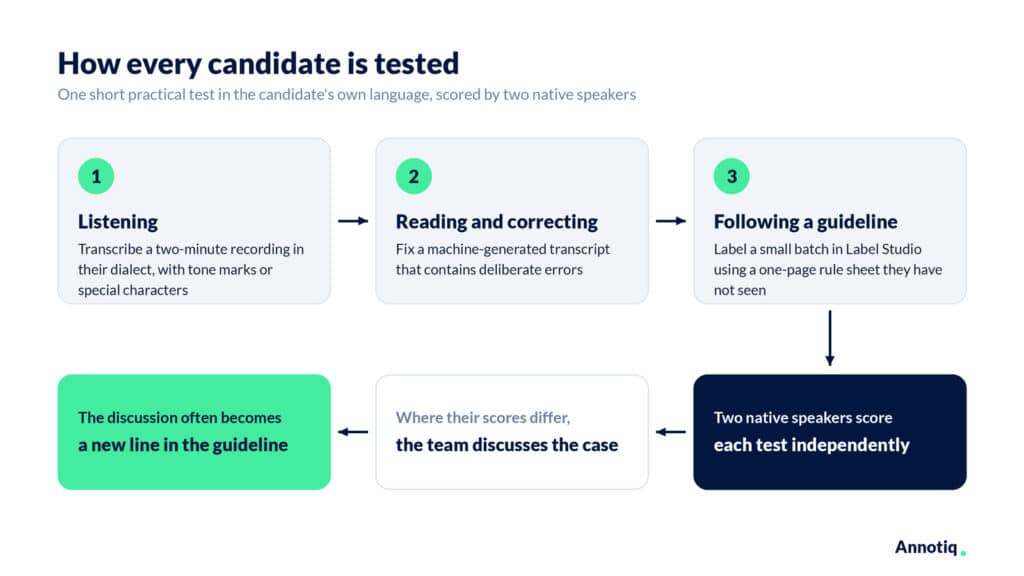
Two native speakers score each test independently. Where they disagree, we discuss the case, and that discussion often becomes a new line in the guideline.
Languages beyond the ten
Clients often ask for languages we do not staff today. We have recruited for new languages at a smaller scale, and the process is the same: find a few strong speakers through referrals, test them, then build out the team around them. It takes weeks. Telling a client that early saves everyone a difficult conversation later.
If you’re working on African-language data and want to compare notes, we’re happy to talk. Follow Annotiq on LinkedIn for more from the team.
What is a native speaker annotator?
A native speaker annotator grew up speaking a language and now transcribes, labels or reviews AI training data in it. At Annotiq, that person also needs to read and write the language well, match the dialect of the data, follow written guidelines exactly and hold steady attention over long sessions.
Which African languages does Annotiq work in?
Annotiq works with native speaker annotators in ten languages: Hausa, Yoruba, Igbo, Bini (Edo), Urhobo, Itsekiri, Efik, Ibibio, Fulfulde and Twi.
Is speaking a language fluently enough to annotate it?
Fluency is the starting point. Many fluent speakers went to school in English and rarely write their home language, and writing Yoruba with tone marks or Hausa with its hooked letters is a separate skill. Annotation also means following written rules exactly, which some excellent speakers find frustrating.
Why does dialect matter in speech transcription?
Dialects change how words sound and how they get written down. Yoruba spoken in Oyo, Ekiti and Lagos differs in ways that change transcription, so an annotator working on recordings from Ibadan should know how Ibadan speakers sound.
How does Annotiq test native speaker annotators?
Every candidate takes a short practical test in their own language. They transcribe a two-minute recording in their dialect, correct a machine-generated transcript that contains deliberate errors, and label a small batch using a one-page rule sheet they have not seen before. Two native speakers score each test independently, and any disagreement between them often becomes a new line in the guideline.
Can Annotiq work in a language outside the ten?
Yes.The team finds a few strong speakers through referrals, tests them, then builds out the team around them. Recruiting for a new language takes weeks, so Annotiq tells clients this at the start of the conversation.